

Network management gets harder as environments become more distributed, more dynamic, and more dependent on clean infrastructure data. The old approach of keeping addresses in spreadsheets, updating subnets by hand, and relying on tribal knowledge no longer scales well when teams need speed, accuracy, and auditability.
That is why IP address management has become a foundational operational function rather than a side task. When it is handled well, engineers can trust the network map, move faster during changes, and reduce the chance of address conflicts, blind spots, and configuration drift. When it is handled poorly, the network becomes harder to support than it should be.
Lumics approaches this problem from a practical angle. Instead of treating IPAM as a separate administrative burden, it includes the capability inside a broader monitoring platform, which matters because address data is most valuable when it is connected to real network behavior.
Why Address Data Breaks Down So Easily

The problem with IP addressing is not that it is conceptually difficult. The problem is that it changes constantly. Devices are added, retired, reassigned, segmented, or temporarily reserved. Static assignments get forgotten. DHCP scopes drift from their original assumptions. Teams inherit networks with incomplete documentation. Over time, even a well-run environment can accumulate contradictions between what the records say and what the network is actually doing.
This is where many operations teams lose time. They do not lose it on the address itself; they lose it on verification. A technician sees an IP in a ticket, then has to check multiple places to understand whether it is active, what hostname it maps to, which subnet it belongs to, and whether that information is still reliable.
In practice, weak IP address management creates three kinds of waste:
- Time spent validating basic facts that should already be known
- Risk from duplicate, stale, or misclassified addresses
- Slower troubleshooting because network context is fragmented
The strategic issue is simple: if your address inventory is not trustworthy, every downstream decision becomes slower and less certain.
What Network Teams Actually Need From IPAM
Good IPAM is not just a list of addresses. It is a control layer for the network. Teams need to see what exists, what is free, what is reserved, what is configured through DHCP, and what can be tied back to real devices and services. They also need the information to be usable fast enough that it helps in daily operations, not just during periodic audits.
A strong system should support planning and verification at the same time. That means helping engineers answer practical questions like these:
- Which subnet is already in use, and how densely?
- Which addresses are static, DHCP-managed, or reserved?
- What hostname or DNS data is attached to an address?
- Which entries look stale, and which are likely active?
- What changed since the last scan?
That is where the value of integrated IP address management becomes clear. In Lumics, the function is not isolated from the rest of the platform. It sits inside a broader monitoring workflow, so the address data is connected to devices, scan results, and operational context instead of living in a disconnected spreadsheet.
From Inventory To Operational Confidence
The real job of IPAM is not storage. It is confidence. Engineers should be able to make changes without stopping to question whether the records are already outdated. When the inventory is centralized and easy to search, sort, and filter, teams can move from “what do we think is true?” to “what is actually present right now?”
That shift matters in incident response, onboarding, expansion planning, and routine maintenance. A network team that trusts its data spends less time reconciling records and more time improving the environment.
How Lumics Reduces The Administrative Cost Of IPAM
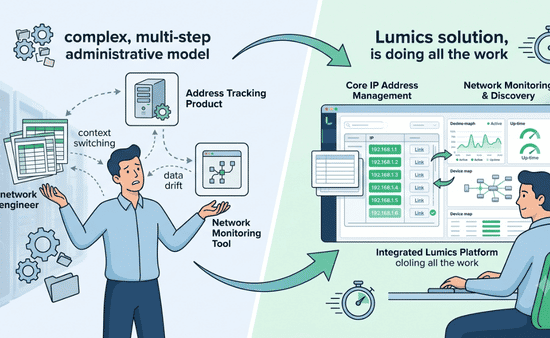
One of the strongest signals of a mature platform is whether it removes operational friction instead of adding another tool to maintain. Lumics does this by including core IP Address Management capability in the base platform pricing, which means teams do not need to buy a separate address-tracking product just to manage a basic part of network operations.
That is not just a procurement detail. It changes behavior. When IPAM is bundled into the same system that already monitors the network, there is less incentive to let records drift into a parallel spreadsheet workflow. There is also less context switching for engineers who need to move between monitoring, discovery, and address administration.
Lumics is built for speed and simplicity, which is especially useful in environments where the priority is actionable data rather than software administration. The platform is designed to help network and systems professionals do the actual work of network management, not spend half their time maintaining tooling.
The integrated model also supports better discipline around data hygiene. Because the address inventory sits beside live monitoring information, it is easier to spot inconsistencies, confirm whether a subnet is actually in use, and reduce dependence on manual updates.
Why Bundled Functionality Matters
A separate IPAM product can be powerful, but it also introduces extra setup, another interface, another data source, and another place for drift to begin. When the same operational platform handles monitoring and IPAM together, the organization gets a cleaner workflow.
That is especially valuable for smaller teams or lean operations groups that cannot afford to manage duplicated systems. Lumics keeps the focus on practical utility, which is often exactly what a network engineer wants from core infrastructure software.
Discovery And Automation Make The Inventory Useful
An address list is only useful if it stays current. That is why discovery and automation matter as much as the inventory itself. Lumics includes automatic subnet discovery, and if routers and switches are already monitored in the platform, the system can recognize subnets and help populate the environment without forcing a manual rebuild from scratch.
That is a meaningful operational advantage. A new deployment does not have to begin with hours of spreadsheet entry. Instead, the platform can use existing monitored infrastructure to build a more complete picture of the network sooner.
The same logic applies to scheduled scans. Automated scan schedules help maintain freshness without requiring engineers to remember to run checks manually. Over time, that improves the reliability of the data and reduces the chance that stale records survive simply because no one had time to update them.
A useful IPAM workflow should also help with identification, not just storage. In Lumics, discovered IP addresses can be tied to reverse DNS lookup results, which gives teams a better starting point for understanding what an address belongs to and where it may have come from. Combined with DNS management, subnet tracking details, and team comments, the record becomes more than a label. It becomes a working reference.
What Good Automation Should Reveal
Automation is not valuable because it looks advanced. It is valuable because it surfaces the right facts quickly. In a well-run system, automated discovery should help answer questions such as:
- Is this address active or unused?
- Does it resolve to a meaningful name?
- Is it in the expected subnet?
- Is it tied to a known device or service?
- Has it shifted since the last scan?
Those are operational questions, not theoretical ones. Lumics is useful because it addresses them inside a monitoring environment that already reflects the live state of the network.
Where IPAM Delivers The Most Business Value

The best way to judge network management tools is by the problems they prevent. IPAM pays off most clearly when teams are under pressure to move fast without making avoidable mistakes. That includes expansions, troubleshooting, migrations, and day-to-day maintenance across mixed device types and ownership models.
Consider a few common scenarios.
- A team is preparing a subnet expansion. With reliable address tracking, it can see utilization, reserved space, and obvious gaps before making a change. That reduces the chance of collision or fragmentation.
- A support engineer receives a ticket with only an IP and a symptom. With better address data, the engineer can quickly identify the subnet, hostname, DNS mapping, and likely ownership, which shortens triage.
- A newly inherited network has limited documentation. Automated discovery and centralized visibility help surface the actual topology faster than manual auditing alone.
- A distributed operations team needs to keep different groups aligned. Customizable organizational hierarchies and team comments help preserve ownership context, so the records reflect more than just technical state.
For teams evaluating Lumics, the important point is not that IPAM is a separate feature to admire. It is that address management becomes more actionable when it lives next to real monitoring data. That combination produces better decisions, less duplication, and faster follow-through.
The Long-Term Advantage Is Operational Trust
The real return on IP address management is not just cleaner records. It is trust in the operating model. When engineers can search, filter, discover, and verify without fighting the tool, they work from evidence rather than assumption. That changes how quickly the team can respond and how confidently it can scale.
Lumics is positioned well for that kind of environment because it keeps the workflow lightweight, centralizes core data, and avoids the cost and complexity of splitting monitoring from IPAM into separate systems. The result is a more practical network management stack: one that helps teams see what they have, understand what it means, and act without unnecessary friction.
If the network is the environment your team depends on, then the address inventory should be treated like infrastructure, not paperwork.