The traditional classroom is no longer the only environment where children can thrive academically and personally. Taking education outside transforms the natural world into a dynamic, interactive laboratory.
Studies have shown that children who spend regular time engaging in outdoor learning environments exhibit better test scores, a more highly developed sense of self, and significantly improved cognitive function. Beyond academic metrics, natural environments foster critical thinking, problem-solving, and emotional resilience.
If you are looking to step beyond the four walls of a standard classroom, implementing structured yet flexible outdoor activities can make a world of difference. Here is an insightful look at five practical ideas for engaging outdoor learning, designed to help educators and parents provide enriching educational experiences that students will love.
1. Nature-Based Sensory Stations

Children learn best when multiple senses are engaged simultaneously. Nature provides the ultimate multi-sensory environment, naturally offering visual, tactile, and auditory stimuli that cannot be replicated indoors.
A nature-based sensory station allows children to explore textures, colors, and sounds at their own pace. By interacting with pinecones, smooth river rocks, coarse bark, and rustling leaves, children refine their tactile processing and learn to interpret their physical world.
According to pediatric occupational therapists, sensory play builds nerve connections in the brain’s pathways, which leads to the child’s ability to complete more complex learning tasks. Setting up a sensory station is incredibly straightforward.
Tip: Create a dedicated “mud kitchen” or a natural sorting table where children can mix dirt, water, leaves, and pebbles. Provide them with measuring cups and wooden spoons. This not only engages their senses but subtly introduces early mathematical concepts like volume and proportion.
2. Interactive Physics with Modern Play Structures
Playgrounds are much more than spaces for burning off excess energy; they are functional physics classrooms. When children climb, swing, and balance, they are actively experimenting with gravity, momentum, and friction. Furthermore, navigating these structures provides vestibular and proprioceptive benefits. Elevation and distance changes help kids acquire crucial knowledge about their bodies’ limits and spatial orientation.
When designing or utilizing an outdoor space for education, the quality of the physical environment matters. Schools and community centers often collaborate with playground equipment manufacturers in Idaho and surrounding regions to build spaces that safely challenge students’ motor skills. A well-designed post and deck system or a sprawling lateral rope course requires children to plan their physical routes, testing cause-and-effect in real-time.
Tip: Challenge children to test how different body positions affect their speed down a slide, or have them time how long it takes a pendulum swing to complete a full arc. This turns a standard recess period into an engaging, hands-on physics lesson.
3. Botanical Scavenger Hunts

A botanical scavenger hunt is a fantastic way to introduce children to biology, ecology, and environmental science. Instead of passively looking at pictures of plants in a textbook, students actively participate in identifying local flora and fauna. This active learning approach increases retention rates and fosters a deeper appreciation for environmental conservation.
Research indicates that active, movement-based learning improves focus and memory retention. By turning a biology lesson into a game, students are far more likely to remain engaged and absorb the material. They learn to categorize leaves by shape, identify indigenous tree species by their bark, and spot the subtle differences between various insects.
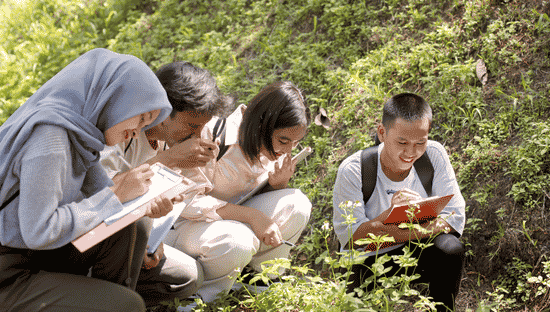
Tip: Provide students with magnifying glasses, a printed checklist of local plants, and a small notebook. Ask them to sketch one interesting leaf or bug they find. This seamlessly integrates science with art and observation skills.
4. Outdoor Art and Creativity Zones
Nature has inspired artists for centuries, and it serves as the perfect backdrop for creative outdoor education. Taking art classes outside removes the constraints of keeping a classroom tidy and encourages students to think big. An outdoor creativity zone allows children to use natural materials as both their medium and their canvas.
Using the environment for art helps children develop fine motor skills and spatial awareness. Making leaf rubbings, building stick sculptures, or tracing shadows as the sun moves across the sky teaches children about light, perspective, and design.
Tip: Set up a temporary art installation area using washable chalk, natural pigments, and found objects. Task students with creating a collaborative mosaic out of fallen leaves, pebbles, and twigs. It teaches teamwork, design planning, and the concept of ephemeral art, as the wind will eventually blow their masterpiece away.
5. Ecological Mini-Gardens
Planting and maintaining a mini-garden is a long-term outdoor learning project that teaches responsibility, patience, and the fundamental life cycles of living things. When children plant a seed and watch it grow, they witness biology in action. They learn about the critical roles of sunlight, water, and soil nutrients, and they get to see firsthand how ecosystems function on a micro-level.
School gardens have been linked to improved nutritional awareness, as children are much more likely to try eating vegetables that they have grown themselves. It also provides a practical platform for teaching weather patterns and seasons.
Tip: Use fast-growing plants like radishes, beans, or sunflowers to keep younger children engaged, as they will see tangible progress in just a few days. Assign specific tasks, such as watering or measuring the plants’ weekly growth, to give students a sense of ownership over the project.
Educators and parents alike can harness the power of the natural world to create dynamic, memorable educational experiences. By integrating sensory exploration, physical play, biology, art, and ecology into daily routines, outdoor learning becomes a cornerstone of a well-rounded, holistic education that prepares children for a lifetime of curiosity.