
Business leaders must balance efficiency, employee satisfaction, and profitability, with labor being the largest expense and critical asset. Poor management can lead to overstaffing or understaffing.
Workforce management (WFM) solves this by using advanced staffing models to align with changing demands, skills, and employee preferences, turning human resources into a growth advantage.
Understanding Workforce Management

At its core, workforce management is an institutional process that maximizes the performance levels and competency of an organization. It involves all the activities needed to maintain a productive workforce. In practical terms, WFM is about having the right number of people, with the right skills, in the right place, at the right time.
While it originated in call centers and manufacturing, WFM principles now apply across retail, healthcare, hospitality, and banking. A robust WFM strategy moves beyond basic administrative tasks and focuses on optimizing productivity and reducing risk.
Key Components of WFM
To implement effective management, you must master several moving parts:
- Forecasting: This is the foundation of WFM. It involves predicting future workload volume based on historical data and upcoming trends. Accurate forecasting prevents the panic of being short-staffed during a rush or paying for idle time during a lull.
- Scheduling: Once the forecast is set, schedules must be built to match the predicted demand. This involves aligning shift patterns with employee availability, labor laws, and union rules.
- Performance Management: This involves monitoring adherence to the schedule and the quality of work being performed. It ensures that the staff on the clock are actually contributing to business goals.
- Intraday Management: Even the best plans can go awry. Intraday management is the process of monitoring the current dayâs operations and making real-time adjustments to cover unexpected absences or sudden spikes in volume.
Types of Staffing Models
There is no one-size-fits-all approach to staffing. The model you choose depends on your industry, your budget, and the nature of your work. Most organizations rely on one of three primary structures.
Traditional Staffing
The traditional model is built on stability. It typically relies on full-time employees working set schedules (such as the standard 9-to-5 or fixed shift rotations).
- Pros: This model fosters a strong company culture and high employee loyalty. Staff members are fully integrated into the team, have deep institutional knowledge, and offer consistent performance.
- Cons: It is rigid. If demand spikes unexpectedly, the fixed capacity of a traditional team may lead to burnout or service failure. Conversely, during quiet periods, you are paying full overhead for underutilized staff.
Flexible Staffing
Driven by the rise of the gig economy, flexible staffing relies heavily on part-time employees, temporary workers, and contractors. This model is often purely demand-driven.
- Pros: It offers incredible agility. Businesses can scale up or down rapidly without the long-term commitment of full-time salaries and benefits. It is highly cost-effective for businesses need backup with volatile seasonality.
- Cons: High turnover is common, and training costs can skyrocket. It is also difficult to build a cohesive team culture or maintain consistent quality standards when the workforce is constantly rotating.
Hybrid Staffing
The hybrid model seeks to capture the best of both worlds. It utilizes a core group of full-time employees to maintain stability, leadership, and culture, supplemented by a flexible layer of part-time or contract staff to handle peaks in demand.
- Pros: This offers the stability needed for long-term growth and the agility needed for short-term fluctuations. It protects core staff from burnout while keeping labor costs optimized.
- Cons: It requires the most sophisticated management. creating schedules that integrate different worker types can be administratively complex without the right tools.
Implementing Effective Staffing Models
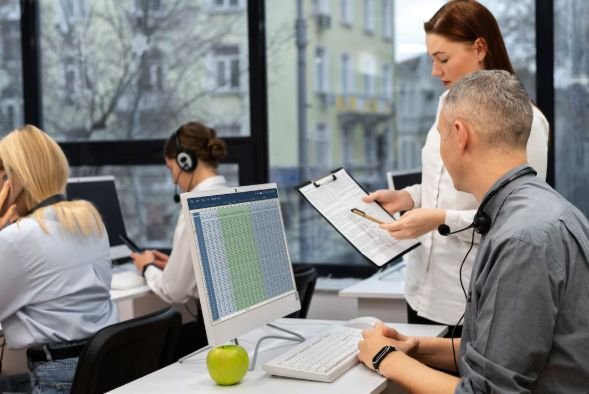
Choosing a model is only the first step. Executing it successfully requires data, technology, and a focus on human development.
Data Analysis for Demand Forecasting
Gut feelings are not a strategy. Effective staffing relies on rigorous data analysis to predict work volume. By analyzing historical trends, seasonal patterns, and marketing calendars, managers can anticipate needs with high accuracy.
For example, in customer support environments, utilizing contact center analytics can reveal specific times of day or days of the week when interaction volume spikes, allowing managers to layer in flexible staff exactly when they are needed most. This data-driven approach minimizes the guesswork and ensures that budget is spent where it yields the highest return.
Technology Solutions for Workforce Management
Managing a hybrid workforce using spreadsheets is a recipe for error. As staffing models become more complex, manual processes fail. Modern WFM software solutions automate the heavy lifting.
These platforms can generate optimized schedules in seconds using AI, taking into account employee preferences, skills, and labor compliance rules. They also offer self-service portals where employees can swap shifts or request time off, which improves engagement and reduces administrative overhead.
Training and Development
Even the perfect schedule will fail if the employees cannot do the job. A staffing model must include a robust strategy for training and development.
For flexible staff, training needs to be efficient and targeted to get them up to speed quickly. For core staff, development should focus on upskilling and career progression. When employees feel invested in, they are more likely to stay, reducing the costly cycle of recruiting and onboarding.
Cross-training employees to handle multiple roles also adds another layer of flexibility to your staffing model, allowing you to move resources internally as demand shifts.
Conclusion
Workforce management is evolving toward greater agility and profitability. Remote work has enabled “follow-the-sun” models using a global talent pool for continuous operation, while AI is set to streamline forecasting and shift manager focus to strategy.
By utilizing data, technology, and employee well-being, organizations can build a resilient, successful workforce.