

The production of Constellations at Horizon Theatre Company blends science, romance, and theatrical ingenuity to explore how a relationship can shift infinitely depending on choices and chance. Nick Payne’s bold two‑character play is intellectually provocative, emotionally engaging, and theatrically daring. This review breaks down the performances, staging, themes, pacing, and why this production remains fascinating even when the concept risks repetition.
Constellations isn’t a conventional love story. Instead, it’s a romantic drama told through waves of parallel realities, testing the boundaries of narrative structure and emotional resonance. It is a play that rewards attentive audiences and invites repeated thinking long after the curtain falls.
Understanding Constellations
Constellations is a two‑hander play written by Nick Payne that follows the evolving relationship between Roland, a humble beekeeper, and Marianne, a physicist who studies quantum mechanics and cosmology. The title itself hints at its thematic ambition: the idea of interconnected patterns, infinite possibilities, and the unknown constellations of choice that influence life and love.
Rather than unfolding in linear fashion, the play presents the couple in multiple iterations of the same pivotal moments. A small change — a choice, a phrase, a pause — alters the course of their connection. Whether they meet, stay together, drift apart, or find reconciliation depends on the subtle variations in each scene.
This abstract structure evokes scientific explorations of the multiverse and string theory, yet Constellations roots its heart in human complexity — how people communicate, miscommunicate, reconcile, and evolve through shared experience.
Plot Synopsis — A Relationship in Multiple Realities

Image Source: Horizon Theatre Company
The play opens with Roland and Marianne meeting against the backdrop of ordinary life, but the story quickly diverges into repeated sequences that vary in outcome. Some versions find the couple falling deeply in love, while others explore tensions and heartbreaks born from missteps, infidelity, and the reality of human fragility.
Roland’s warm, unpretentious personality contrasts Marianne’s sharp, cosmological mind. Her reflections on possibilities and alternate universes are echoed in the structure of the play itself: what if this had happened instead? What if that choice had been different? The narrative invites the audience to live through those choices with the characters.
Performances — Chemistry Meets Technical Precision
In Horizon Theatre Company’s production, the two performers must carry the entire play on their shoulders, and the success of the show largely depends on their chemistry and range.
The actors playing Roland and Marianne bring charm, emotional clarity, and remarkable versatility to their roles. Because the same scene can be repeated with different emotional inflections, timing, or subtext, each movement demands nuance and attention to detail. The audience witnesses not just two characters interacting, but multiple versions of their selves, each shaped by choice and chance.
Reviewers of earlier productions have consistently praised the actors’ ability to carry this demanding material, noting how their naturalistic performances make the high‑concept structure feel authentic and emotionally grounded.
Direction and Staging — Balancing Concept with Intimacy
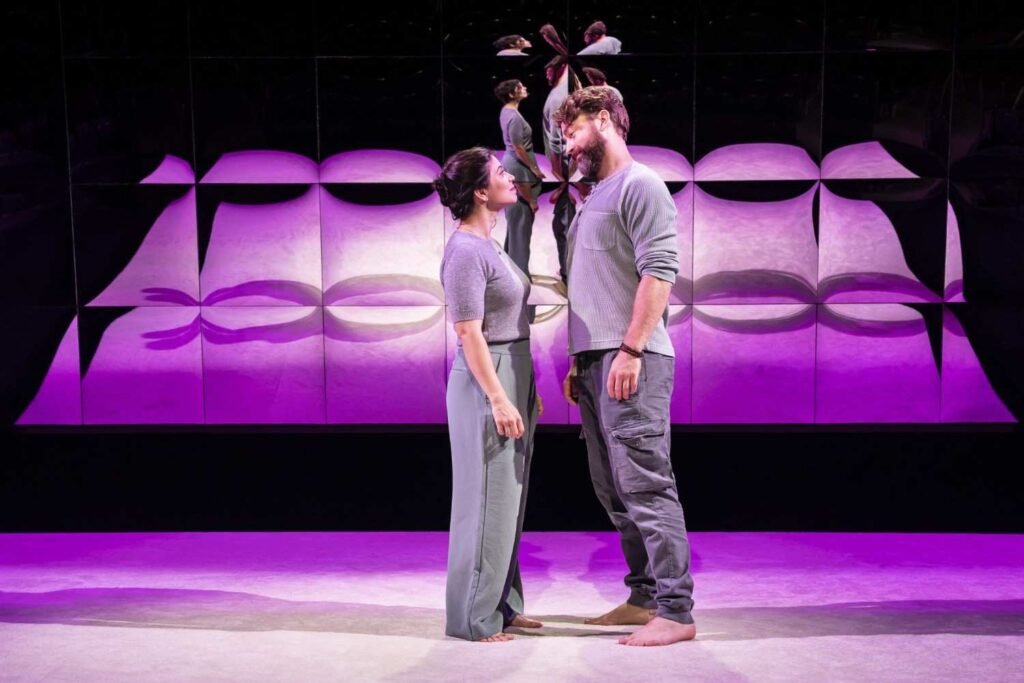
Image Source: Newcity Stage
Director Justin Anderson (in the Horizon staging) and creative teams embrace simplicity and subtle theatrical devices to distinguish between iterations. Lighting cues, minor shifts in posture, and sound transitions are often enough to signal which version of reality the audience is watching.
The staging is minimalist but effective. With carefully placed benches, suspended elements that suggest cosmic strings, and lighting variations that evoke different worlds, the production creates a sense of expansiveness within a modest performance space. This approach allows audiences to focus on the evolving emotional landscape of the characters rather than elaborate scenery.
However, some critics have noted that the repetition — intentional and thematic — can begin to feel mechanical or slightly tiresome after many reiterations, making the viewer more aware of structure than story at times.
Themes That Resonate
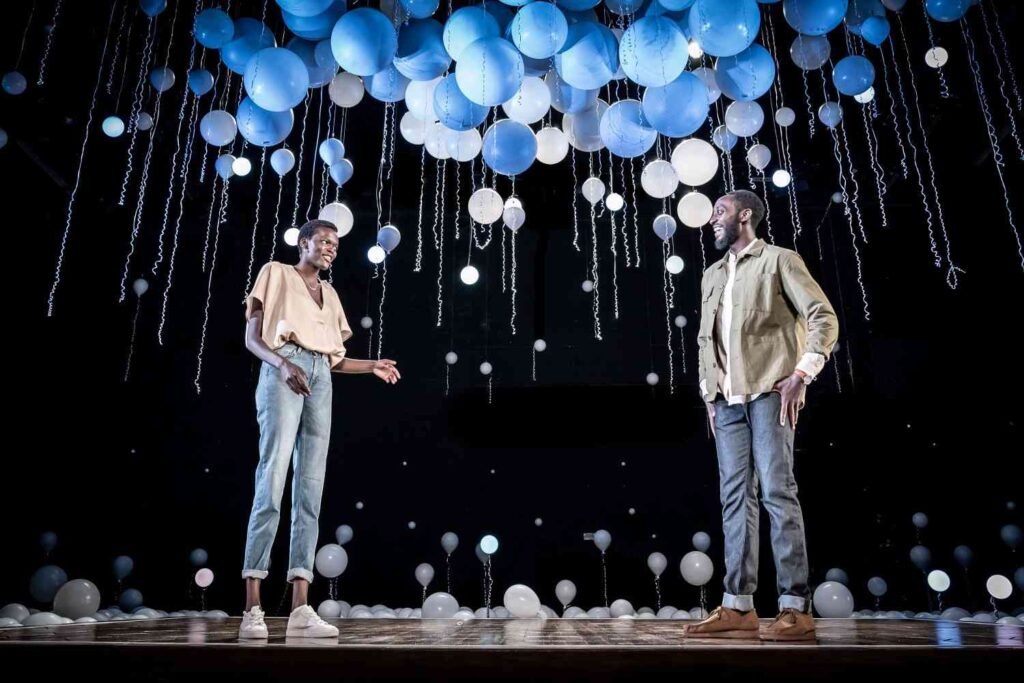
Image Source: Time out
Love Across Possibilities
At its core, Constellations is about how relationships evolve based on decisions both conscious and unconscious. It asks, explicitly and implicitly: How much of our connection is determined by chance and how much by choice? The multiverse concept becomes a romantic metaphor for all the roads not taken in love.
Choice, Chance, and Causality
Payne’s play embraces the intellectual allure of quantum theory and the multiverse to explore causality in human lives. Each slight variation emphasizes how a small divergence — a pause, a word, or a glance — can lead to vastly different emotional outcomes.
Communication and Missed Signals
The repetitive structure underscores how often people repeat patterns in communication and experience — sometimes recognizing what worked and sometimes becoming trapped in cycles that push them apart. Each iteration becomes a miniature lesson in the fragility and power of human connection.
Strengths of the Play
Constellations excels in several areas:
- Intellectual Depth: Its concept engages with scientific and philosophical ideas without overwhelming the emotional narrative.
- Emotional Clarity: Despite its abstract structure, the play remains grounded in recognizable human experiences — love, longing, uncertainty, and connection.
- Performances: The actors shine in their ability to explore variation within the same moments, injecting authenticity into every iteration.
- Minimalist Design: Subtle staging choices highlight the play’s themes without distracting from the central relationship.
Critiques and Limitations
Some critics pointed out that Constellations can feel repetitive — almost like variations on a single idea rather than expanding dramatically into new emotional territory.
While repetition is a deliberate choice tied to the play’s exploration of alternate realities, it can at times become overly rigid, making certain sequences feel less alive and more demonstrative.
Moreover, because the play is so focused on structure, some audience members may find that it invites intellectual fascination more than visceral emotional connection. This isn’t necessarily a flaw, but it does mean Constellations appeals most strongly to theatre‑goers who enjoy conceptual storytelling alongside character intimacy.
Frequently Asked Questions
1. What genre is Constellations?
It’s a romantic drama with scientific and philosophical depth, structured around alternate realities.
2. How long is the play?
The typical run time is around 80 minutes with no intermission.
3. Is it suitable for all audiences?
The play contains mature themes and requires attention to subtle shifts in narrative, so it’s best suited to adult audiences with an appreciation for minimalist theatre.
4. What makes this production unique?
Its blend of science‑inspired structure with a deeply personal love story, alongside strong performances in a two‑actor piece.
Final Thoughts — A Thoughtful and Unconventional Romance
Constellations at Horizon Theatre Company is a rare theatrical experience. It’s neither a straightforward love story nor a dry scientific lecture. Instead, it bridges both worlds, inviting audiences to contemplate relationships through the lens of infinite possibility. The production’s strength lies in its performances and its invitation to reflect on how life might change with every decision.
While the concept may feel repetitive at times, the subtle emotional shifts and thematic richness make it well worth experiencing. This is a play that doesn’t just show how a relationship unfolds; it shows how it might unfold differently based on the slightest choice — and in doing so, it mirrors the unpredictable, beautiful complexity of real life.