
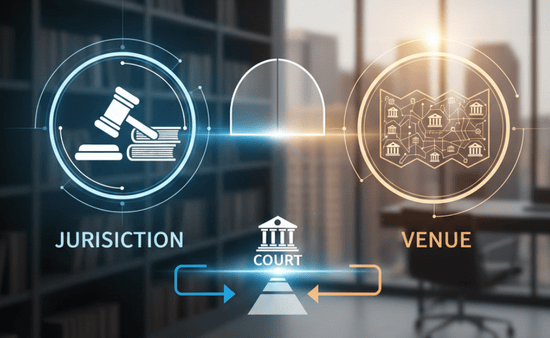
To proceed with a lawsuit, a case must satisfy two procedural requirements: jurisdiction and venue. Jurisdiction refers to a court’s legal authority to issue a binding decision, while venue determines the specific geographic location or courthouse where the trial will be held. Incorrectly establishing either can result in delays, transfers, or the dismissal of the case.
The Basics: What Are Jurisdiction and Venue?
At a high level, the difference comes down to authority versus geography.
Jurisdiction refers to a court’s legal power and authority to hear a specific case and make a binding decision on the parties involved. If a court lacks jurisdiction, any judgment it renders is void. It is a fundamental question of power: Does this court have the right to speak on this matter?
Venue, on the other hand, refers to the specific geographic location where the lawsuit is heard. It is about the “neighborhood” where the trial takes place. While a state might have jurisdiction over a case, venue rules determine which specific county or district courthouse is the proper place for the trial to happen.
Types of Jurisdiction
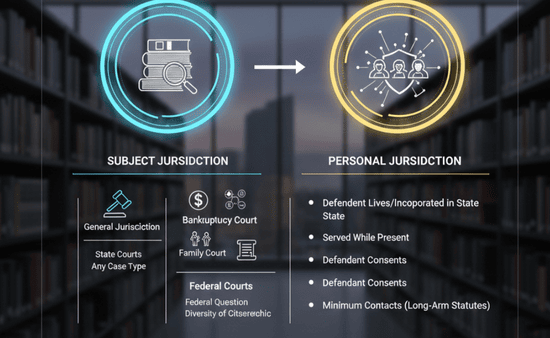
For a court to have the power to hear a case, it generally needs two types of jurisdiction: subject matter jurisdiction and personal jurisdiction.
Subject Matter Jurisdiction
This refers to the court’s authority over the specific type of law or dispute involved in the case. Courts are often divided by the types of cases they can hear.
- General Jurisdiction: State courts usually have general jurisdiction, meaning they can hear almost any type of case, from contract disputes to personal injury claims.
- Limited Jurisdiction: Some courts are specialized. For example, a bankruptcy court can only hear bankruptcy cases; a family court handles divorce and custody; and a probate court handles wills and estates.
- Federal vs. State: Federal courts have limited subject matter jurisdiction. They typically only hear cases involving a “federal question” (issues arising under the U.S. Constitution or federal laws) or “diversity of citizenship” (where the parties are from different states and the amount in controversy exceeds $75,000).
Personal Jurisdiction
Even if the court has authority over the type of law (subject matter), it must also have authority over the people or entities involved. This is personal jurisdiction.
A court automatically has personal jurisdiction over the plaintiff (the person filing the suit) because they voluntarily submitted to the court by filing the case. The challenge is usually establishing authority over the defendant. Generally, a court has personal jurisdiction over a defendant if:
- The defendant lives or is incorporated in the state.
- The defendant is served with the lawsuit while physically present in the state.
- The defendant consents to the jurisdiction.
- The defendant has sufficient “minimum contacts” with the state (e.g., they do business there or caused an accident there), allowing the state’s “Long-Arm Statutes” to reach them.
Original vs. Appellate Jurisdiction
It is also helpful to distinguish between original and appellate jurisdiction. Original jurisdiction belongs to the court that has the right to hear the case first—usually a trial court. Appellate jurisdiction belongs to higher courts that have the power to review the decisions made by the lower trial courts.
Venue Explained
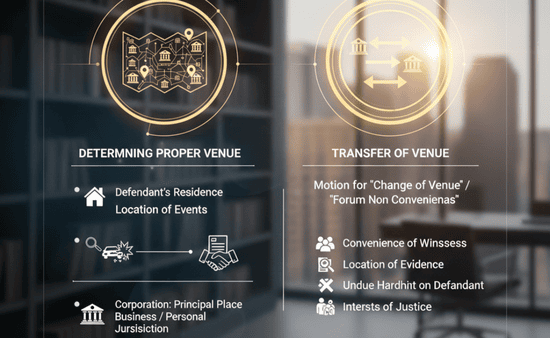
Once jurisdiction is established, you must determine the venue. Venue rules exist to ensure the location of the trial is fair and convenient for the parties and witnesses.
Determining Proper Venue
In civil cases, venue is typically considered proper in:
- The defendant’s residence: The county or district where the defendant lives.
- The location of events: The county or district where a substantial part of the events giving rise to the claim occurred (e.g., where the car accident happened or where the contract was signed).
If a defendant is a corporation, venue is usually proper where the corporation has its principal place of business or where it is subject to personal jurisdiction.
Transfer of Venue
Sometimes, a plaintiff files a case in a technically correct venue, but it is incredibly inconvenient for the defendant or the witnesses. In these instances, a defendant can file a motion for a “change of venue” or “forum non conveniens.”
The court weighs several factors when deciding whether to transfer venue, including:
- The convenience of the witnesses.
- The location of the evidence.
- Undue hardship on the defendant.
- The interests of justice.
If the court agrees that another venue is significantly more appropriate, they may transfer the case to that location.
Jurisdiction vs. Venue: Key Differences
While both concepts determine where a lawsuit proceeds, the distinction lies in their rigidity and purpose.
- Purpose: Jurisdiction is about constitutional power and authority. Venue is about procedural convenience and fairness.
- Waiver: A lack of subject matter jurisdiction can never be waived. If a court doesn’t have the power to hear a tax case, the parties cannot just agree to let them hear it. However, venue is a privilege of the defendant. If a defendant does not object to an improper venue early in the case, they are often considered to have waived their right to complain about it.
- Consequence: A lack of jurisdiction usually leads to dismissal. An improper venue usually leads to the case being transferred to the correct location.
A Practical Example
Imagine a driver from California gets into a car accident with a driver from Nevada while visiting Las Vegas.
- Jurisdiction: The Nevada courts likely have personal jurisdiction over the California driver because the accident happened within Nevada borders (minimum contacts).
- Venue: The specific venue would likely be the county court in Las Vegas (Clark County) because that is where the event occurred.
If the Nevada driver tried to sue the Californian in a Florida court, the Florida court would lack personal jurisdiction (no power over the driver) and would likely lack proper venue (no connection to the event).
How These Rules Affect Legal Cases
The strategic selection of where to file a lawsuit is known as “forum shopping.” While laws prevent blatant abuse of this practice, lawyers often look for the most favorable jurisdiction and venue allowed by law.
The location can significantly impact the case outcome. Different courts have different local rules, varying jury demographics, and different judicial tendencies. Furthermore, the convenience factor plays a massive role in litigation costs. If a party has to travel across the country for every hearing, their legal fees and travel expenses will skyrocket, potentially forcing a settlement.
This is why local expertise is vital. For example, experienced litigation attorneys in Utah will understand the nuances of local district courts compared to federal options within the state, helping clients choose the forum that offers the best chance of success while strictly adhering to procedural laws.
Conclusion
Filing a lawsuit is rarely as simple as filling out a form. The rules regarding jurisdiction and venue are complex, involving state statutes, federal laws, and constitutional requirements. A misstep in the initial filing can lead to wasted time, wasted money, and the potential loss of your right to sue.