
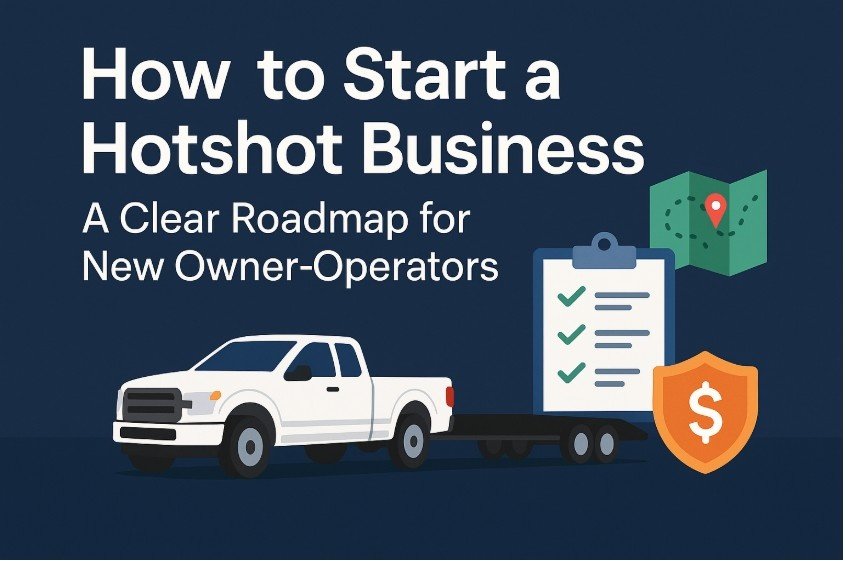
If you’ve been Googling how to start a hotshot business, you’re probably picturing a pickup, a flatbed trailer, and the freedom of being your own boss. Hotshot trucking can absolutely be that—but only if you set it up legally, safely, and with realistic numbers in mind.
Below is a simple, U.S.-focused roadmap that walks you through what hotshot trucking is, what you need to stay compliant, and how to avoid the most expensive beginner mistakes.
What Is Hotshot Trucking and Is It Right for You?
Hotshot trucking is a niche of the trucking industry that focuses on smaller, time-sensitive loads—usually moved with a heavy-duty pickup and a flatbed or gooseneck trailer instead of a full semi. These loads are often construction materials, equipment, or industrial parts that need to be delivered fast.
Many beginners start with non-CDL hotshot work, where the combined weight rating of the truck, trailer, and cargo stays under 26,000 pounds. That lets you operate without a CDL, though you still fall under federal safety rules when you’re over 10,000 pounds in interstate commerce.
Before you spend money, decide if the lifestyle fits: you’ll manage your own schedule, find your own freight, track your miles, and handle repairs. If you like independence, logistics, and driving, this can be a good fit. If not, it can quickly turn into an expensive headache.
How to Start a Hotshot Business: Step-By-Step Guide

1. Clarify your business model
Decide whether you’ll run as an owner-operator with your own authority or lease on to an existing carrier. Running under your own authority offers more control and profit potential but comes with higher startup costs, more paperwork, and stricter oversight. Leasing onto a carrier shifts some compliance and dispatching to them, in exchange for a cut of your revenue.
Build a basic business plan: what equipment you’ll use, what lanes you’ll run, how many miles per week you need, and which shippers or brokers you’ll target.
2. Set up your legal structure and registrations
Choose a business structure (many hotshotters use an LLC for liability protection) and get an EIN from the IRS.
If you’re hauling freight for hire across state lines, you’ll almost always need:
- A USDOT number, which identifies you as a motor carrier.
- Operating authority (MC number), because you’re an authorized for-hire carrier transporting regulated property for compensation.
You apply for both through FMCSA’s Unified Registration System (URS). Once approved, you’ll enter the New Entrant Safety Assurance Program, where your safety performance is monitored closely for the first 18 months.
Depending on your weight and where you operate, you may also need IRP/IFTA registrations and UCR. Check your state’s DOT site and FMCSA guidance before you run your first load.
3. Understand CDL vs non-CDL hotshot
- Non-CDL hotshot: combined truck + trailer + cargo weight rating under 26,001 pounds.
- CDL hotshot: anything 26,001 pounds GCWR or above, or certain hazmat or passenger configurations.
Many beginners spec their truck and trailer to stay just under the 26,000-pound threshold. However, that limits what you can legally haul. If you plan to grow or haul heavier machinery, budgeting for a CDL and heavier-duty rig from the start may make more sense.
What Licenses, Authority, and Insurance Do You Need?
Besides your USDOT and MC numbers (for interstate, for-hire work), you must meet federal and state safety rules. That typically includes:
- Medical exam and certificate if you’re a commercial driver.
- Driver Qualification File (DQF) for non-CDL interstate drivers operating 10,001–26,000 pounds GCWR.
- Compliance with Hours of Service rules and, in many cases, ELD requirements.
Insurance is a big piece of the puzzle. For most hotshot carriers, brokers and shippers expect:
- Primary liability (often $1,000,000 limit)
- Cargo insurance (commonly $100,000, sometimes more)
- Physical damage on your truck and trailer
First-year premiums can easily run from $7,000 to $18,000 or more, depending on your equipment, location, and driving history.

How Much Does It Cost to Start a Hotshot Business?
Your startup budget will vary, but realistic ranges are significant. Industry breakdowns suggest initial investments like:
- Truck: roughly $30,000–$70,000
- Trailer: roughly $8,000–$20,000
- Other equipment (chains, straps, tarps, PPE, tools): $2,000–$5,000
- First-year insurance: $7,000–$18,000
- Licensing, permits, and fees: $500–$1,500
Total startup cost estimates for a hotshot operation often land in the $50,000–$190,000 range, depending on equipment choices and working capital.
That’s why you should also include a cash reserve for fuel, maintenance, and slow weeks. Hotshot rates might average around $1.50–$2.00 per mile in many markets, but your profit depends on deadhead miles, fuel, and how efficiently you book loads.
Frequently Asked Questions
1. Do you need a CDL to start a hotshot business?
Not always. You don’t need a CDL if your combined truck, trailer, and cargo stay under 26,001 pounds GCWR and you’re not hauling certain hazmat or large passenger loads. However, once you cross that 26,000-pound threshold, a CDL is required, and many hotshot rigs hit that quickly when fully loaded. Even as a non-CDL hotshot driver, you must comply with FMCSA rules when you’re over 10,000 pounds in interstate commerce, including maintaining a driver qualification file and following Hours of Service rules.
2. How much can you make with a hotshot business?
Earnings vary widely based on your lanes, equipment, and how well you manage expenses. Some carriers report rates around $1.50–$2.00 per mile, with total startup and operating costs that can easily eat half of that if you’re not careful. Your true income depends on how many loaded miles you run, how much deadhead you accept, your fuel efficiency, and your financing or lease payments. Think in terms of profit per mile after all costs—not just revenue per mile—before you decide whether the numbers work.
3. How do you find loads for hotshot trucking?
Most new hotshot operators start with load boards and freight brokers that specialize in partial and expedited loads. Over time, the goal is to build direct relationships with local construction firms, equipment dealers, and manufacturers so you’re not relying entirely on the spot market. Many successful hotshot carriers track which lanes and shippers pay best, negotiate for better rates as they prove reliability, and eventually build a small book of regular customers while still using boards to fill gaps in their schedule.
4. Is hotshot trucking still worth it with current fuel and insurance costs?
Hotshot trucking can still make sense, but it’s not an easy, guaranteed win. Rising fuel prices, high first-year insurance premiums, and competitive rates mean you need solid cost control and planning. The carriers who tend to succeed treat it like a real business: they know their cost per mile, avoid underpriced loads, maintain their equipment to prevent expensive breakdowns, and keep some cash reserve. If you approach it as a structured, numbers-driven business rather than a quick side hustle, you’ll have a better chance of making it work.
Ready to Hit the Road With Your Hotshot Business?
Learning how to start a hotshot business is really about understanding the rules, the costs, and the math behind every mile. When you build on a solid foundation—proper authority, the right equipment, realistic startup capital, and a clear plan to find freight—you give yourself a much better chance of turning your truck and trailer into a sustainable, long-term business instead of an expensive experiment. Take the time to plan, run the numbers honestly, and treat every decision like it affects your future on the road—because it does.