
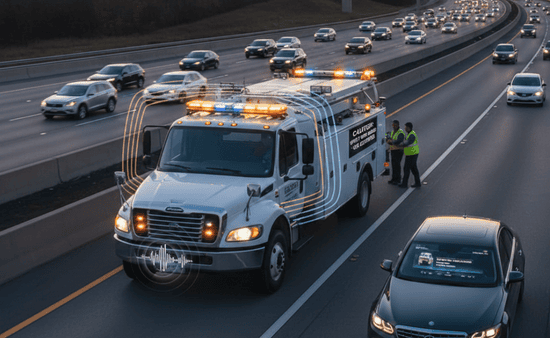
Driving past a utility truck on the side of a busy highway or navigating around a delivery vehicle on a narrow street can be a tense experience for any motorist. For the fleet operators and drivers of those vehicles, however, that tension is a daily workplace hazard. Visibility is the first line of defense in preventing roadside accidents, but in an era of distracted driving and soundproofed luxury cabins, bright lights alone are no longer enough.
This is where advanced signaling technology steps in. The industry is moving beyond simple strobe lights toward intelligent, integrated systems designed to communicate clear messages to approaching drivers. By leveraging automation, synchronization, and smart connectivity, modern fleets are setting new standards for roadside safety.
Moving Beyond “More Brightness”
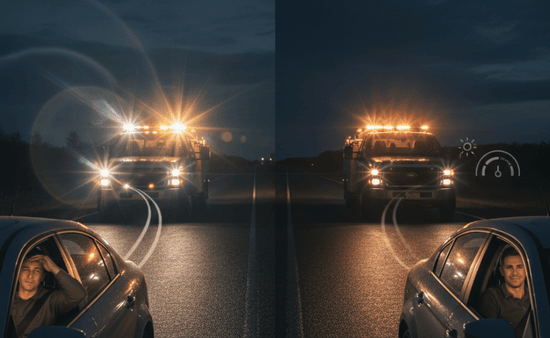
For decades, the philosophy behind emergency and utility lighting was simple: brighter is better. The transition from rotating halogen bulbs to high-intensity LEDs marked a massive leap forward in visibility. However, simply adding more lumens to a vehicle can sometimes have the opposite of the intended effect.
Overly bright, unsynchronized flashing patterns can cause glare that blinds oncoming drivers or creates a “moth-to-flame” effect, where drivers are inadvertently drawn toward the lights they are trying to avoid. Advanced signaling technology focuses on the quality and intelligence of the light, rather than just raw intensity.
Modern systems utilize dimming features that automatically adjust based on ambient light sensors. A warning light that needs to be seen from a mile away at noon is blindingly dangerous at midnight. Intelligent systems can dampen that intensity instantly when the sun goes down, ensuring the vehicle is seen without dazzling passing motorists.
The Power of Synchronization
One of the most significant advancements in fleet safety is the ability to synchronize flash patterns across the entire vehicle. In the past, a truck might have had a light bar on the roof, grill lights, and perimeter lights all flashing on independent, clashing separate circuits. The result was often a chaotic visual storm that made it difficult for approaching drivers to determine the vehicle’s size, orientation, or distance.
Newer signaling architecture allows all lighting heads to communicate with a central controller. This enables “system-wide” flash patterns. When every light flashes in unison or in a coordinated sequence, it creates a clear visual outline of the vehicle. This helps other drivers instantly recognize the presence of a work truck and judge its position on the road more accurately.
This is particularly important when selecting equipment. While many fleet managers might just look for standard light bars for trucks, opting for a system that supports synchronization capabilities can drastically improve the effectiveness of that hardware. A coordinated perimeter defines the workspace, making the environment safer for the crew on the ground.
Automated Warning Systems and Situation Awareness
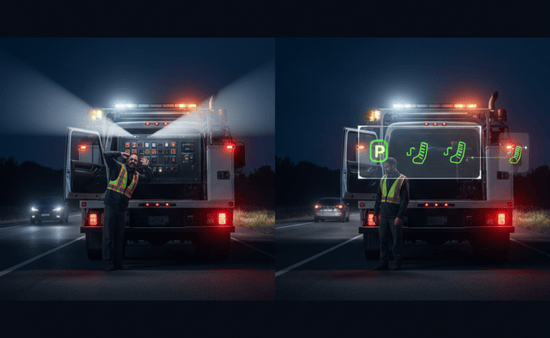
A major goal of advanced signaling is to reduce the cognitive load on the fleet driver. When an operator arrives at a job site, they have a dozen things to worry about—traffic, the task at hand, and equipment setup. Fiddling with a switch box to find the right warning pattern shouldn’t be one of them.
Integration with the vehicle’s Controller Area Network (CAN bus) allows the signaling system to react to the vehicle’s status automatically.
- Park vs. Drive: The system can automatically switch from a “moving” warning pattern to a “blocking” pattern the moment the transmission is shifted into Park.
- Door Activation: If a driver opens their door, the lightbar can cut power to the corner modules on that side to prevent blinding the driver as they exit the cab.
- Brake Integration: Warning lights can override their standard flash pattern to act as auxiliary brake lights when the pedal is pressed, providing extra warning to trailing traffic.
By automating these functions, fleets ensure that the lighting is always optimized for the specific situation without relying on human memory.
V2X: The Next Frontier in Signaling
The cutting edge of signaling technology isn’t visual at all—it’s digital. Vehicle-to-Everything (V2X) communication is slowly making its way into fleet operations. This technology allows a work truck to broadcast a digital signal to nearby civilian vehicles.
Instead of relying solely on a driver seeing a flashing light, V2X sends an alert directly to the dashboard infotainment system or navigation app of approaching cars. A driver might see a notification popping up on their screen: “Caution: Utility Work Ahead.”
This digital layer of safety creates a buffer zone long before visual contact is made. It is particularly effective around blind corners, over hills, or in dense fog where physical lights might be obscured. While still in the early stages of widespread adoption, V2X represents the bridge between traditional hardware and the connected autonomous future.
Improving Acoustic Signaling
Visuals are only half the equation. Modern passenger vehicles are built with exceptional sound insulation to block out road noise. This makes traditional sirens and backup alarms less effective than they used to be.
To combat this, fleets are adopting low-frequency sound technology. often referred to as “howlers” or “rumblers.” These devices emit low-frequency sound waves that can penetrate solid materials, including the glass and steel of modern cars. Drivers can physically feel the vibration of the sound before they hear the higher pitch of a standard alarm, prompting them to check their mirrors and surroundings sooner.
Investing in a Safer Workspace
The road is the office for millions of fleet operators, and it remains one of the most dangerous work environments in the world. As traffic density increases and driver attention spans shorten, the technology used to protect these workers must evolve.
Advanced signaling is no longer just about meeting minimum compliance standards. It is about utilizing smart, integrated systems to create a cohesive safety bubble around the vehicle. By prioritizing synchronization, automation, and digital connectivity, fleet managers can ensure that their teams are not just visible, but truly understood by the traffic around them.