

We often grow up with a fairytale notion of love: “happily ever after” means no fighting, no disagreements, and certainly no raised voices. But anyone who has been in a long-term partnership knows the reality is far messier. Conflict is as natural to relationships as breathing. When two distinct individuals with different backgrounds, needs, and stress triggers share a life, friction is inevitable.
The Anatomy of Healthy Conflict
Healthy conflict isn’t about being polite all the time. It can be heated, emotional, and difficult. The distinguishing factor is the underlying foundation of safety and respect. In healthy disagreements, both partners are ultimately fighting for the relationship, not against each other.
Characteristics of Constructive Disagreement

When conflict is healthy, it tends to follow a specific pattern of engagement. Even when tempers flare, there are guardrails in place that prevent the argument from going off a cliff.
- Respectful Communication: Even in anger, partners avoid crossing the line into contempt. There is no name-calling or mocking. The focus stays on the issue at hand rather than attacking the other person’s character.
- Active Listening: This is more than just waiting for your turn to speak. In healthy conflict, partners genuinely try to understand the other’s perspective. You might hear phrases like, “What I’m hearing you say is…” or “Help me understand why this upset you.”
- Empathy: Healthy partners can validate feelings even if they disagree with the facts. You can think your partner is wrong about the sequence of events, but still have empathy for their feelings of hurt or frustration.
- Repair Attempts: These are crucial. A repair attempt is any gesture—a joke, a touch, an apology—that prevents negativity from escalating out of control. In healthy relationships, these attempts are made and, crucially, accepted.
The Surprising Benefits of Fighting Fair
Ideally, conflict serves a functional purpose. It acts as a pressure release valve and a course-correction mechanism.
Strengthened Bonds: Surviving a tough argument and coming out the other side with a resolution creates a unique kind of intimacy. It proves to both partners that the relationship is resilient enough to handle hard truths.
Mutual Understanding: You learn a lot about a person by what makes them angry. Conflict reveals boundaries, values, and deep-seated needs. Every resolved argument is a data point that helps you navigate your partner better in the future.
Personal Growth: Often, the things that trigger us in a relationship point to our own unresolved issues. Healthy conflict forces us to confront our own defensiveness, selfishness, or insecurities, pushing us to mature.
What It Looks Like in Practice
Imagine a scenario where one partner forgets a significant anniversary.
In a healthy conflict dynamic, the injured partner expresses their hurt: “I feel really undervalued and forgotten when you miss our anniversary.” The other partner, though perhaps defensive at first, listens and acknowledges the impact: “I am so sorry. I know I messed up, and I can see why that hurts you. I’ve been swamped at work, but that’s no excuse.”
They move toward a solution: setting shared calendar alerts or planning a make-up date. The conflict happened, feelings were expressed, and a resolution was reached without character assassination.
Recognizing the Signs of Unhealthy Conflict
Unhealthy conflict is destructive. It is cyclical, unresolved, and leaves one or both partners feeling psychologically battered. Over time, this type of fighting erodes trust until the relationship feels unsafe.
The Four Horsemen and Other Red Flags
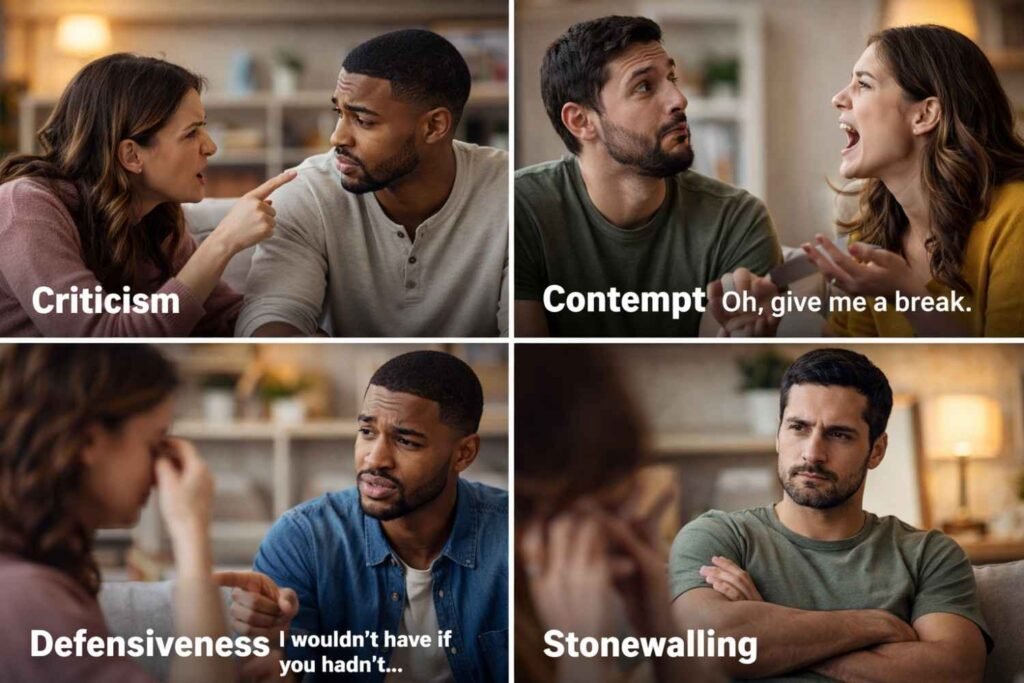
1. Criticism: Attacking your partner’s core character. Instead of “I’m upset you didn’t do the dishes,” it becomes “You are so lazy and selfish.”
2. Contempt: This is the most dangerous behavior. It involves treating your partner with disrespect, using sarcasm, eye-rolling, or mockery. It communicates disgust.
3. Defensiveness: Instead of taking responsibility, a defensive partner plays the victim or counterattacks. “I wouldn’t have forgotten if you hadn’t distracted me!”
4. Stonewalling: Shutting down completely. One partner withdraws from the interaction, refusing to respond or engage, which often sends the other partner into a panic.
Beyond the Four Horsemen, unhealthy conflict is characterized by aggression (yelling, intimidation) and coercion. If you feel you must agree just to stop the fighting, that is not a resolution; it is submission.
The High Cost of Toxic Fighting
When arguments are toxic, nothing gets solved. The same fight happens over and over, often escalating in intensity.
Emotional Distress: Living in a state of constant, volatile conflict keeps the nervous system on high alert. This leads to anxiety, depression, and physical health issues.
Resentment: Unresolved hurts pile up like debt. Over time, this accumulation of resentment creates a wall between partners that becomes impossible to climb over.
Relationship Damage: Trust is fragile. Once you have crossed the line into verbal abuse or deep contempt, it is incredibly difficult to walk it back. The emotional safety required for intimacy vanishes.
Examples of Destructive Dynamics
Let’s revisit the anniversary scenario.
In an unhealthy dynamic, the injured partner might attack: “You forgot again? You are such a selfish jerk. You never care about anyone but yourself.”
The other partner retaliates: “Oh, give it a rest. You’re so needy. Maybe if you didn’t nag me all the time, I’d actually want to celebrate with you.”
One partner storms out (stonewalling), and the other is left crying. No apology is offered, no plan is made to fix it, and the resentment simmers until the next explosion.
Transforming the Battlefield into Common Ground

If you recognize your relationship in the “unhealthy” section, don’t panic. Patterns are learned behaviors, which means they can be unlearned. Shifting from toxic to healthy conflict requires intention, patience, and often a willingness to swallow your pride.
Communication Techniques That Work
Use “I” Statements: This is a classic for a reason. “You always make a mess,” a defense invites. “I feel overwhelmed when the house is cluttered,” invites empathy. Focus on your feelings and needs rather than your partner’s shortcomings.
The “Time-Out” Rule: When physiological arousal (heart rate, adrenaline) gets too high, our brains literally cannot process logic. We go into fight-or-flight mode. Agree beforehand that either partner can call a “time-out” to cool down for 20 minutes before resuming the discussion.
Stay on Topic: Avoid “kitchen-sinking”—throwing every past grievance into the current argument. If you are fighting about the budget, don’t bring up your mother-in-law or the trash from last week. Deal with one issue at a time.
The Role of Professional Help
Sometimes, the patterns are too deeply ingrained to fix on your own. If your arguments frequently devolve into screaming matches, if you feel unsafe, or if you are stuck in a cycle of silent resentment, therapy can be a game-changer.
Couples counseling provides a neutral space to deconstruct these dynamics. A therapist can act as a referee and a translator, helping you hear what your partner is actually saying beneath the anger.
However, it is also important to recognize when a relationship has passed the point of no return. If abuse is present or if one partner refuses to engage in the work of repair, seeking legal counsel might be the necessary next step. A compassionate divorce lawyer in Salt Lake City, Utah, can help you navigate the end of a relationship with dignity, ensuring that stepping away from the conflict is the start of a healthier life, not a failure.
Self-Reflection is Key
Finally, look in the mirror. You cannot control your partner’s behavior, but you have 100% control over your own. Ask yourself difficult questions: Do I listen to understand, or to reply? Do I hold grudges? Am I quick to apologize? Changing your side of the street often prompts a shift in the entire relationship dynamic.
Conclusion
Perfection isn’t the goal—connection is found in repair. Conflict in relationships isn’t a problem; avoiding it is. Shift from “avoiding fights” to “fighting better,” and turn conflict into a tool for growth. Staying present during hard moments and admitting when you’re wrong takes courage, but it leads to a partnership that’s safe, resilient, and deeply understood. The work is worth it.